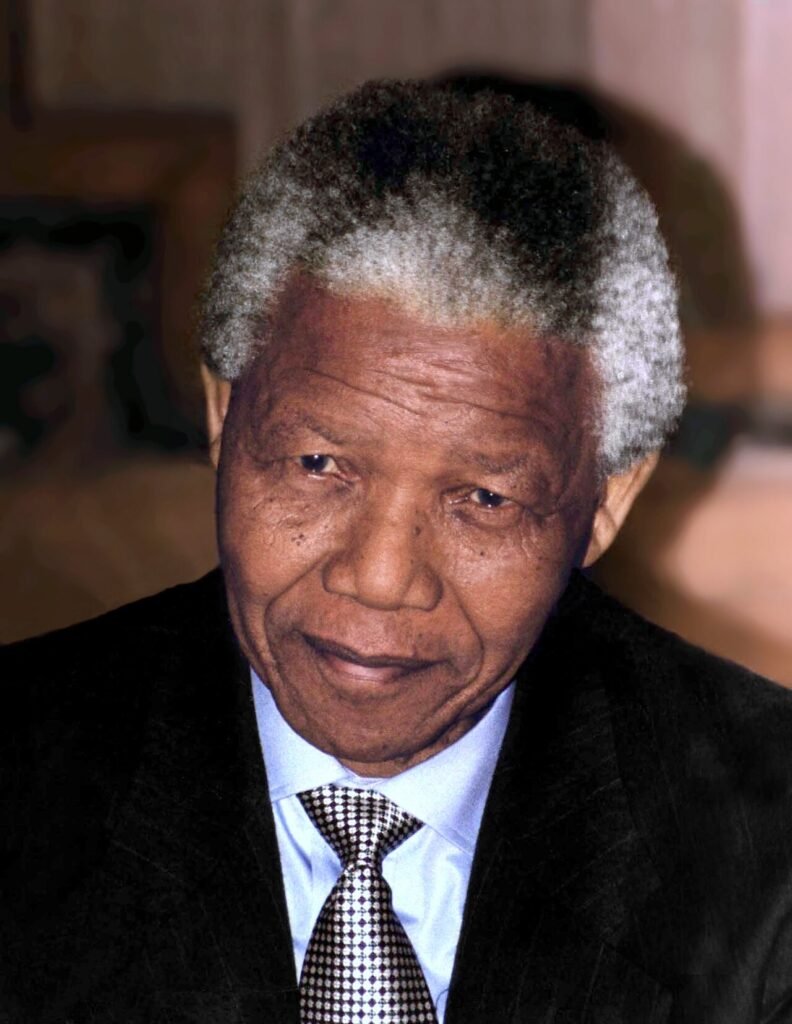
Nelson Mandela is remembered around the world as a symbol of courage, sacrifice and forgiveness. His journey from political prisoner to president helped bring an end to apartheid and shaped modern South Africa.
Early Life
Rolihlahla Mandela was born on 18 July 1918 in Mvezo, a village in what is now the Eastern Cape province of South Africa. He belonged to the Thembu royal house of the Xhosa people, and his clan name, Madiba, later became an affectionate name used by South Africans. A teacher at his primary school gave him the English name Nelson, following a common practice of the time.
After his father died, the young Mandela was raised under the guardianship of the Thembu regent. He attended mission schools and later enrolled at the University College of Fort Hare, one of the few institutions offering higher education to Black South Africans, but he left after taking part in a student protest. He moved to Johannesburg, completed his degree through correspondence and went on to study law at the University of the Witwatersrand.
Career / Rise
In Johannesburg, Mandela became involved in politics through the African National Congress (ANC). In 1944 he helped found the ANC Youth League, which pushed the organisation towards mass action. After the National Party introduced apartheid in 1948, a system of legalised racial segregation, he became one of the leading organisers of resistance, including the Defiance Campaign of 1952.
That same year he and Oliver Tambo opened the first Black-run law firm in South Africa, offering legal help to people affected by apartheid laws. Mandela was among those charged in the long Treason Trial that began in 1956, which ended with the acquittal of all the accused in 1961.
After police killed protesters at Sharpeville in 1960 and the ANC was banned, Mandela helped establish uMkhonto we Sizwe, the ANC’s armed wing. He was arrested in 1962 and, following the Rivonia Trial, was sentenced to life imprisonment in 1964. He spent 18 years on Robben Island and later years in Pollsmoor and Victor Verster prisons, 27 years in total.
Major Achievements
International pressure and negotiations within South Africa led to Mandela’s release on 11 February 1990. He then led the ANC in talks with the government of President F. W. de Klerk to end apartheid peacefully. In 1993, Mandela and de Klerk were jointly awarded the Nobel Peace Prize for this work.
In April 1994 South Africa held its first elections in which citizens of all races could vote, and Mandela became the country’s first Black president. During his single term he focused on reconciliation, a new constitution and the establishment of the Truth and Reconciliation Commission. He chose not to seek a second term and stepped down in 1999.
Legacy
After leaving office, Mandela continued to work on causes such as children’s welfare, education and the fight against HIV/AIDS through his foundations. He died on 5 December 2013 in Johannesburg at the age of 95, and leaders from around the world gathered to honour him.
His autobiography, Long Walk to Freedom, published in 1994, describes his childhood, his political awakening and his years behind bars. It became an international bestseller and introduced his story to new generations of readers.
The United Nations marks his birthday, 18 July, as Nelson Mandela International Day, encouraging people to give their time to community service. His willingness to forgive those who imprisoned him, and to build a nation that included everyone, remains one of the most powerful examples of moral leadership in modern history.
Quick Facts
- Born: 18 July 1918, Mvezo, South Africa
- Died: 5 December 2013, Johannesburg, South Africa
- Nationality: South African
- Known for: Anti-apartheid leader; first democratically elected president of South Africa (1994–1999)
- Honours: Nobel Peace Prize (1993, shared with F. W. de Klerk)
Photo credit: Nelson Mandela, 1994. Photo © John Mathew Smith 2001 (Kingkongphoto & www.celebrity-photos.com), via Wikimedia Commons, licensed under CC BY-SA 2.0.
